The Real Story Behind
Mughlai Ballimaran
تاریخِ نہاری، حکیموں کی حکمت، اور علی گڑھ میں دیگی ذائقے کی اصل داستان
Discover the 300-year culinary journey from the boatmen of the Yamuna and the royal Hakims of Sharif Manzil to Mughlai Ballimaran—an independent heritage restaurant independently preserving sealed copper degh cooking on Anupshahr Road, Aligarh.
Where Did the Name "Ballimaran" Come From?
Long before it became world-renowned for poetry and royal cuisine, the historic quarter of Ballimaran in Shahjahanabad (Old Delhi) derived its name from the Yamuna River waterways. In the 17th century, canals flowed through parts of the Mughal capital. The quarter was settled by skilled boatmen who navigated passenger and cargo barges (*kashtis*) using long, sturdy bamboo steering oars known as balli.
Because these river navigators were called balli-maran (those who steer with bamboo poles), the neighborhood was named after them. As the city expanded and the canals receded, Ballimaran evolved into an aristocratic cultural hub of silver-beaters (*wark-saz*), opticians, and noble physicians.
Mirza Ghalib & Gali Qasim Jan
Ballimaran was immortalized by the legendary Urdu poet Mirza Asadullah Khan Ghalib (1797–1869), who spent his final years in a haveli in Gali Qasim Jan gifted by an admiring Hakim. Ghalib famously celebrated the richness of bone marrow (*nalli*) and slow-cooked degh stews in his gatherings.
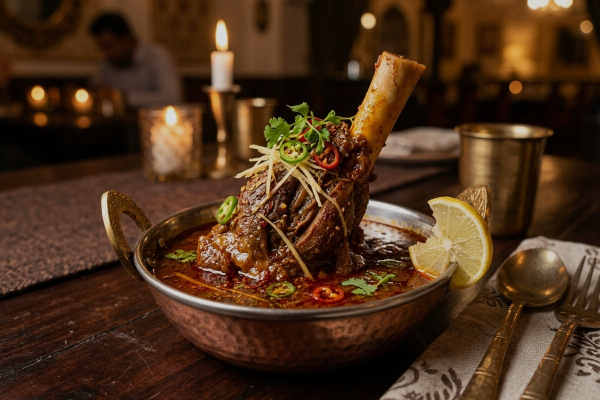
Sealed Copper Degh Dum
"The authentic sealed copper degh (*dum*) technique ensures collagen, bone marrow, and warming spices meld without burning or artificial thickeners."
The Hakims of Sharif Manzil: The Real Birth of Nihari
Nihari was not invented as casual street food. It was formulated in the late 17th and early 18th centuries by the imperial court physicians (**Hakims**) of **Sharif Manzil**, located right inside Ballimaran. Established around 1720 by **Hakim Sharif Khan** (physician to Emperor Muhammad Shah), the *Khandan-e-Sharifi* were pioneers of the Greco-Arabic Unani medical system.
The Concept of "Nahār" (نهار)
Derived from the Arabic word for morning. The Hakims prescribed that this warming, high-collagen bone broth be consumed at dawn immediately after *Fajr* prayers to fortify the body against Delhi’s bitter, damp winter chills.
Ilaaj-bil-Ghiza (Diet Therapy)
Rather than harsh medicines, Unani physicians formulated a blend of over 50 warming spices: Pipli (long pepper), dry ginger (*sonth*), fennel (*saunf*), mace (*javitri*), and cardamom to clear chest congestion and build stamina.
Sustenance for Laborers
During the construction of the Red Fort and imperial monuments, large copper cauldrons of shank meat and marrow were buried in ash pits overnight to feed thousands of stonemasons, granting them all-day energy.
Mughlai Ballimaran, Aligarh
While generic eateries use the name "Ballimaran" across the world, Mughlai Ballimaran in Aligarh is an independent, standalone restaurant with zero connection to impersonal chains.
Gali 3, Green Park Colony
Anupshahr Road, Near FM Tower
Aligarh, UP – 202002
Setting the Authentic Degh in Aligarh
For generations, students, scholars of Aligarh Muslim University (AMU), doctors, and local families had to make the long journey to Old Delhi's Jama Masjid or Ballimaran just to taste authentic, unadulterated Nahari.
Mughlai Ballimaran was established right here on Anupshahr Road to give Aligarh its very own true heritage destination. We operate on four non-negotiable principles:
- 100% Halal Certified Meats: Fresh, verified daily cuts with strict ethical and religious integrity.
- Open Kitchen Transparency: No hidden counters. Guests can observe the sealed copper deghs, live charcoal tandoor, and hygiene protocols.
- No Chemical Food Colors or Thickeners: We achieve rich gravy viscosity solely through overnight marrow gelatin, and golden color through Kashmiri mirch and caramelized onions.
- Clay Tandoor & Live Breads: Piping hot Tandoori Lawasa, Zafrani Sheermal, and Rumali Roti baked live over fire.
Chronicles of the Royal Recipes
Explore the centuries-old stories, royal kitchen folklore, and distinct preparations behind every signature dish at Mughlai Ballimaran, Aligarh.
Bong Nahari
Bong refers to the shank cut of the meat. In Mughal royal kitchens, the shank was prized above all cuts for its dense collagen and long muscle fibers that do not shred during 10 hours of slow degh simmering. It yields spoon-tender meat that melts on the tongue.
Sada Nalli & Mix
The hollow marrow bone (*nalli*) is the unctuous soul of the degh. As the bones simmer overnight, buttery marrow infuses directly into the gravy. Tapping the bone releases molten marrow over your plate—the ultimate royal luxury.
Buff Paya
Trotters hold an ancient place in Central Asian and Mughal healing traditions. Cooked for 12 continuous hours on dying coals, the bones release pure gelatin, calcium, and collagen into a warming broth infused with garlic, cloves, and black pepper.
Buff Stew (Ishtu)
*Ishtu* is the Indian phonetic adaptation of the English word *Stew*. During the 19th century, royal khansamahs adapted bland British stews into an aromatic masterpiece using exclusively whole spices (*sabut masala*)—whole red chillies, coriander seeds, and fresh sliced ginger.
Shami Kabab
Boiled with chana dal (split Bengal gram) and whole spices, then pounded on a traditional stone *sil-batta* until completely fibrous and silken. Shallow pan-seared in fresh ghee to create a delicate crisp exterior and melt-in-mouth core.
Chicken Butter Tasla
Born near the Jama Masjid, this dish takes smoky charcoal-roasted chicken tikka, places it in a traditional metal basin (*tasla*), and drenches it with foaming, sizzling molten Amul butter, spiced curd, and heavy dairy cream.
Tandoori Lawasa
With ancient Central Asian and Afghan roots (*Lavash*), Lawasa traveled to Delhi with the early Mughals. In Old Delhi, it evolved into a thick, pillowy, soft flatbread that remains pliable—making it the ultimate vessel to wrap kebabs and soak up thick Nahari tari.
Zafrani Sheermal
*Sheer* in Persian means *milk*, and *mal* means *to knead*. Invented by royal bakers, water is completely replaced with rich full-cream milk, pure saffron (*zafran*), and ghee. Its gentle sweetness creates an exquisite contrast against spicy Nahari and Qorma.
Shahi Tukda
Slices of bread fried in pure desi ghee until crisp and golden, steeped in saffron-cardamom sugar syrup, and draped under thick, slow-reduced *malai rabri*, garnished with pistachios. The quintessential dessert of Old Delhi daawats.
Experience Authentic Mughlai Ballimaran
Counter takeaway available 1:00 PM – 4:00 PM & 6:00 PM – 10:00 PM. Third-party home delivery available in the evening. Bulk party deghs prepared for family celebrations and AMU events.